- Three Alpha
- Posts
- The World is Watching
The World is Watching
A global effort to monitor the cosmos.

Adam McMaster
March 28, 2026 • Estimated Reading Time: 3 minutes
Welcome to Three Alpha! In this edition of the newsletter we’re focusing on the activation of the Vera Rubin alert stream. Read on for more…
On a mountaintop in Chile, a telescope takes a photograph. Almost immediately, a vast, globe-spanning apparatus swings into action. Data is sent via high-speed fibre optic cables first from the mountain to Santiago, to São Paulo, to Miami, and then to Chicago. From Chicago, it is processed and sent to locations all over the world for further analysis, and then the results are made public. This all happens within minutes of each photograph being taken. A massive effort has gone into setting all this up, applying the ingenuity of countless scientists and engineers to deploying cutting-edge algorithms, all for the purpose of detecting events in the images and then letting us know: something has changed in the sky.
Three Alpha is a free newsletter sent on the last Saturday of the month. Not subscribed yet? Make sure you don’t miss future editions by subscribing now!
As of last month, the alert stream of the Vera C. Rubin Observatory’s Legacy Survey of Space and Time is finally up and running. Full operations haven’t quite started yet, but the observatory’s systems are undergoing their final tests and adjustments. Soon the full survey will start, and then the alerts will come millions of times per night. Twenty years of planning, building, and waiting has led us to this. We’re now keeping track of the night sky like never before.
I’ve written before about the Rubin Observatory: it’s the new observatory in Chile, which includes the largest camera ever built, and which took its first observations last year. It is capable of taking very high resolution, very deep images (meaning, it’s capable of seeing very faint things). And it is going to photograph the entire Southern sky every three days.

Rubin during the 2025 “First Look” observations. The bright object to the right is Jupiter, and the cluster M41 is visible above the telescope. Credit: NSF–DOE Vera C. Rubin Observatory/NOIRLab/SLAC/NSF/DOE/AURA/P. Horálek (Institute of Physics in Opava)
The range of things this will allow us to do is extensive. It’s called a survey of space and time for a reason. Repeatedly monitoring everything at once means we can detect anything that moves or changes. That means everything from asteroids in the solar system, to variable stars in the Galaxy whose brightness fluctuates, to supernovae exploding on the other side of the Universe. We’re about to get a flood of new discoveries like nothing we’ve had before.
The Rubin Observatory is being led by the US (as you’ll have realised if you’ve noticed their insistence on referring to it by the rather cumbersome name NSF–DOE Vera C. Rubin Observatory), but it is actually a massive international project. Astronomers all over the world have been part of the preparations for the observatory beginning operations, and astronomers everywhere will be analysing the massive volume of data the observatory produces.
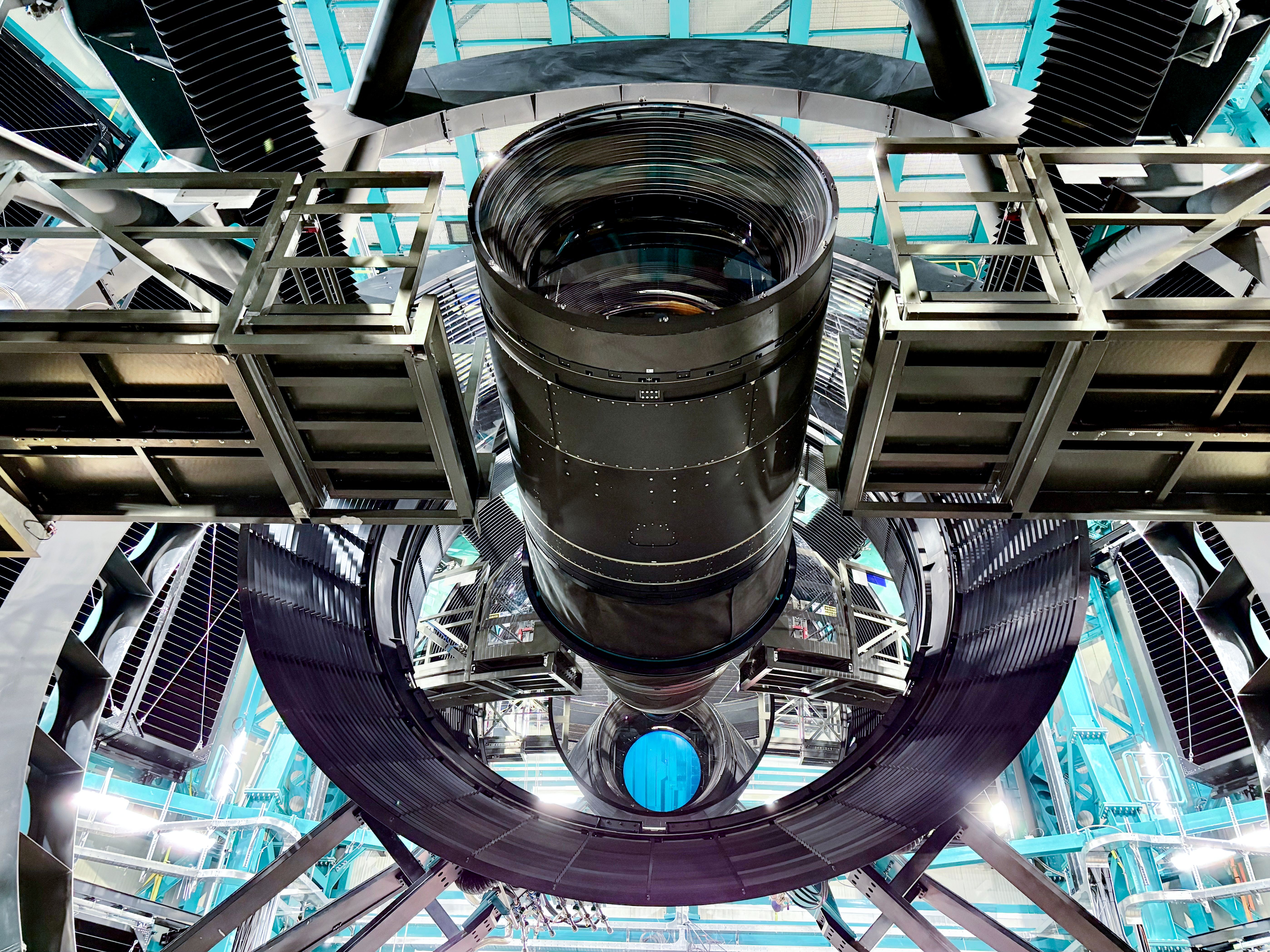
The largest camera ever built, the LSST Camera, is seen here after being installed in the telescope. Credit: RubinObs/NSF/DOE/NOIRLab/SLAC/AURA/T. Lange
The infrastructure that has been set up to handle all that data reflects the global nature of the collaboration. After some light processing at the observatory (on a mountain in Chile), the data is sent to the US, where it is processed in depth. It is then distributed to a global network of “broker” services, which are funded and operated by universities and institutions all over the world. The brokers perform more detailed processing (detecting things such as supernovae) and make the results available to the public (including the many thousands of astronomers eagerly waiting for the data).
Astronomy is a global science. It has always relied on collaboration between astronomers in different parts of the world. After all, no one can see the whole sky from their location. The earliest modern astronomers would write to each other to share observations and results, often despite whatever wars or geopolitical nonsense of the day threatened to get in the way. We still do that today.
What is Three Alpha? Other than being the name of the newsletter you’re reading now, the name “three alpha” comes from the triple-alpha process, a nuclear chain reaction in stars which turns helium into carbon. Read more here.
Who writes this? My name is Dr. Adam McMaster. I’m an astronomer in the UK, where I mainly work on finding black holes. You can find me on BlueSky, @adammc.space.
Let me know what you think! You can send comments and feedback by hitting reply or by emailing [email protected].