- Three Alpha
- Posts
- We Have Always Had the Stars
We Have Always Had the Stars
A few thoughts on the uncertainty of the new year.

Adam McMaster
January 31, 2026 • Estimated Reading Time: 2 minutes
Welcome to Three Alpha! Starting in 2026, we’re changing the newsletter’s publication schedule. Look out for it on the last Saturday of the month. In this edition of the newsletter we’re thinking about humanity’s relationship with the stars. Read on for more…
Humanity has existed for a few hundred thousand years. From our beginning, we have been aware that there is more than our immediate surroundings. We were born in forests and moved to the grasslands. We crossed deserts to find new homes. We learned to cooperate and we built societies. We created civilisation. We became what we are now by our ingenuity and by a desire to find out what is out there.
Through all of that, whatever has happened, we have always had the stars. When humanity was born, generations of stars had already come and gone, the galaxies had already formed, and even the furthest planets from the Sun had completed tens of millions of orbits. We were born into a universe in full swing. Individual stars are born and die. Constellations drift, disappear, and are replaced by whatever new connections humanity’s imagination can draw. But, the stars, collectively, have always been there, arcing across the clear night sky, disinterested when it comes to human events but an indelible backdrop to them nonetheless.
Three Alpha is a free newsletter sent on the last Saturday of the month. Not subscribed yet? Make sure you don’t miss future editions by subscribing now!
The stars have always been a constant. Every time a mad emperor forced his people to go to war, we still had the stars. Through plagues and famines, we had the stars. Through the darkest times, there were a million lights shining above our heads.
You can navigate by the stars. You can untangle the history of everything. You can just spend an evening. For longer than history, people have looked up at night and constructed stories. Stories involving gods and mythical creatures. Stories involving travellers and wanderers. These stories helped us begin to make sense of our world and the Universe. They also served as a distraction from the everyday toil of existence, their grandeur and awe driving us to keep going.
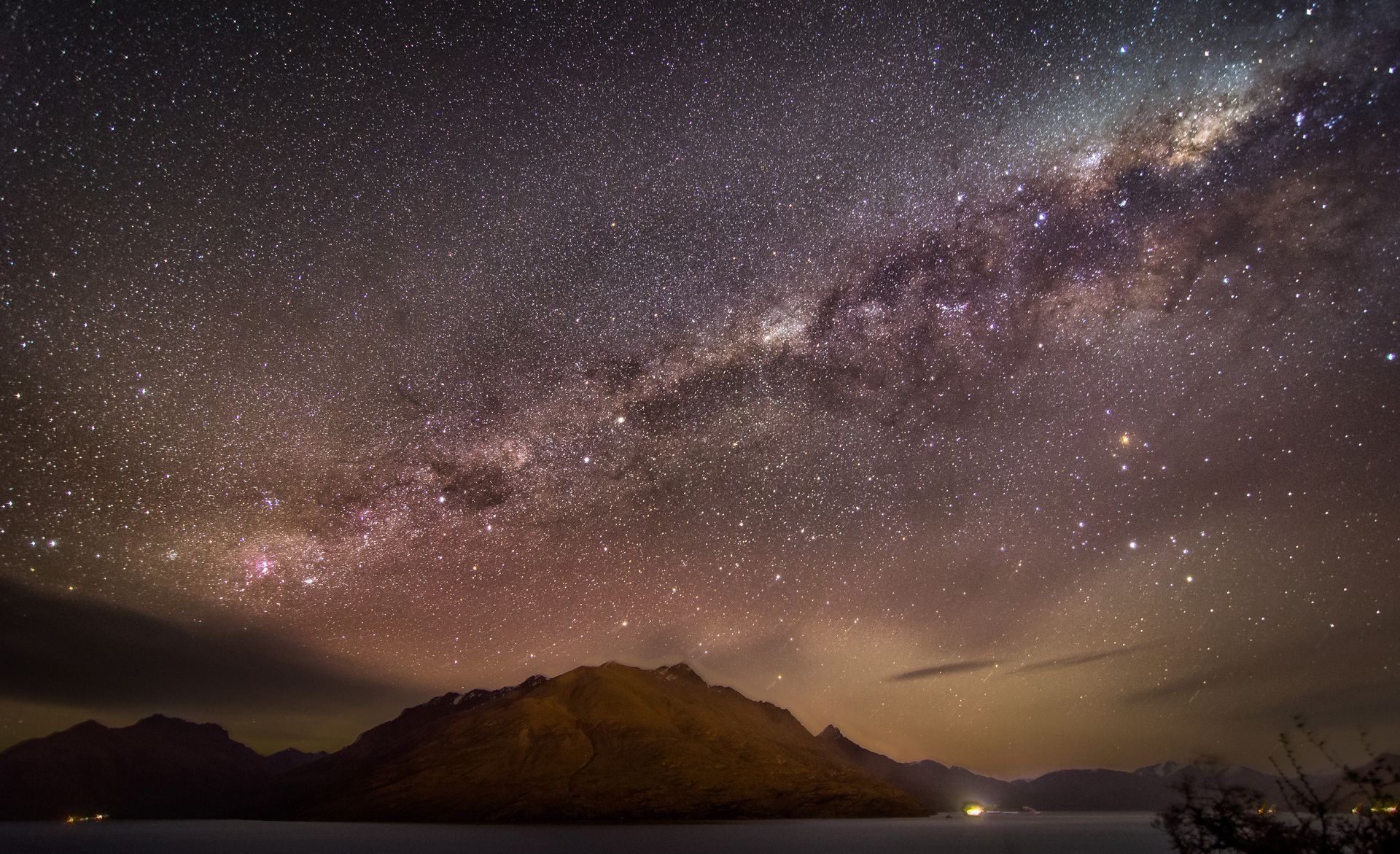
The Milky Way over New Zealand. Credit: Tom Hall (CC-BY)
Today, our view of the stars is better than at any time in history. We can see further than anyone ever has. We can see with more clarity, well beyond the limits of our own eyes. We exploit the full range of the electromagnetic spectrum and, lately, we’re able to see using gravity. New facilities are on the brink of allowing us to see everything, all the time. Soon we’ll be recording how things change from one night to the next, for the whole sky. Who knows what we could find?
We have more to lose now than we ever have.
Our view of the stars has occasionally been threatened. By light pollution in cities. By satellites in orbit. By proposed chemical plants in the desert. By senseless cuts to humanity’s most worthwhile endeavours. When the bastards come for the stars, we always fight back. The chemical plant has been cancelled. We still have to deal with satellites and light pollution. Dictators still try to stifle the search for knowledge and understanding.
Politics is moving so fast it risks coming to an end, while the powerful position themselves to continue by other means. When I look at the stars, I know what will happen next. This one will become a red giant in four billion years. That one will become a black hole. Another will slowly cool and fade until the Universe ends. People are less predictable.
Whatever happens, I hope 2026 is good to you. And if not, I hope you can at least look up for a moment.
What is Three Alpha? Other than being the name of the newsletter you’re reading now, the name “three alpha” comes from the triple-alpha process, a nuclear chain reaction in stars which turns helium into carbon. Read more here.
Who writes this? My name is Dr. Adam McMaster. I’m an astronomer in the UK, where I mainly work on finding black holes. You can find me on BlueSky, @adammc.space.
Let me know what you think! You can send comments and feedback by hitting reply or by emailing [email protected].